How can you easily convey the size of your evil monster to a reader? It’s tough and it’s one aspect of writing I struggled with for a time — achieving scale and the sense thereof. You might write ‘the thing, it was as big as a house,’ but I find something like that to be too vague (and I’d know, I’ve used that before). A house is big, but is it semi-detached, a bungalow or a cottage? In any case, we can do better than that!
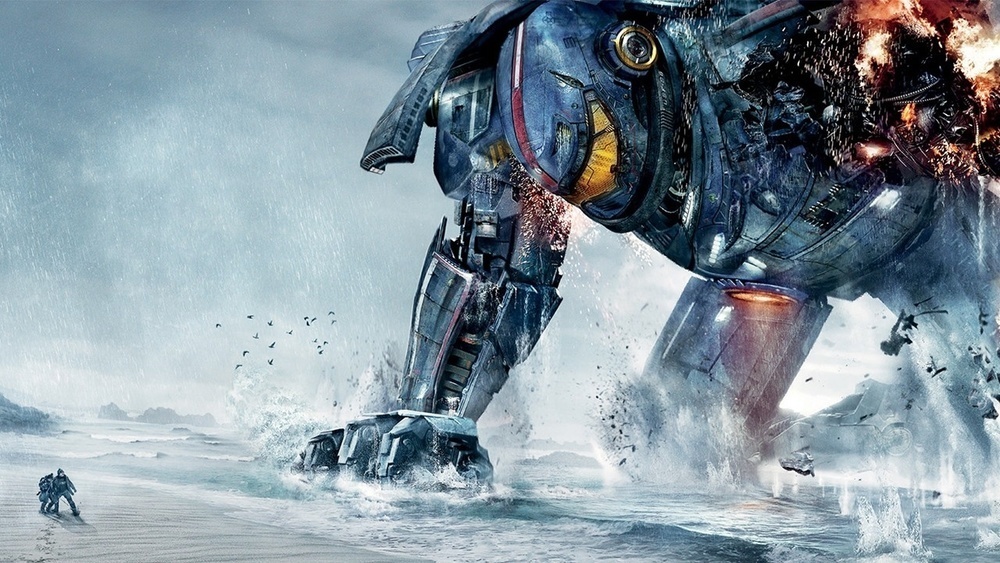
There’s a brilliant scene in Pacific Rim that occurs in the first fifteen minutes; Gypsy Danger is dispatched to take down a Kaiju (as it always is). Due to a never-before-seen ability the Kaiju manifests, Gypsy gets slapped around a bit and suffers critical damage, but not before besting the beastie. We cut to a Father and Son on an indistinct beach some time later; scanning the sands with a metal detector. Suddenly the detector goes haywire and, as the Father looks up from the ground, he sees the enormous Mech appear from the fog, collapse meters away and quietly breathe its last breath. The Father and Son are visually inconsequential in size beside Gypsy and, for the first time in the movie, we the viewer can truly reckon with the enormity of the Mechs dispatched to fight the similarly sized Kaiju — henceforth, an important sense of scale is established.
So, how does one translate that to the written word and, better still, for far smaller subjects?
The Human brain is an awful liar; a good one, but a pathological one. It muddles what it knows to suit its own needs. While we might never fully understand it, the brain has a hard time reconciling with large quantities and sizes. Take a moment and imagine one matchstick; wooden, red-tip, a match. Now, imagine ten; not too hard I think — nice little pile of ten matches. Now… try to imagine one-hundred individual matches. Sure, you can see the larger pile, but you don’t know if there’re one-hundred actually there, do you? The same thing happens if I was to say ‘The battered Mech, as big as the Sydney Opera House, waded as far as the wet sands of the shore before keeling onto its front.’ Doesn’t really give a sense of scale… Your brain knows it’s big, but it doesn’t understand just how big.
If that was the flop and turn, this is the river.
Try this one on for size: ‘Harold lifted his Son up to Gypsy’s broken index finger. After steadying himself, he slipped on the wet metal anyway and rolled into its cupped palm. Those four remaining digits now loomed over him, as tall as buses standing on their ends. Until his Father appeared over the crook of Gypsy’s elbow in the distance, he thought he would be trapped forever.’ Did you see what I did there? If you’re thinking the ‘bus’ simile, you’re wrong unfortunately (sorry). No, I used Harold’s son as a scale. If there’s one thing the human brain knows the proper proportions to, it’s the human body. Then, instead of focusing on the gestalt, I picked one of Gypsy’s limbs at random (a limb we know to be quite small when compared to the rest of us) and blew it up to gargantuan proportions in relation to a whole human.
It’s almost as if I know what I’m talking about…
Only for having done it poorly in the past do I now know the error of my ways. It’s important to make mistakes, but it’s equally as important to make sure you learn from them. Trust me, I’m still learning from mine, but no one becomes a master at their craft overnight; all we can do is try and keep trying to improve.
Thank you for attending my impromptu lesson on scale in written works that nobody asked for. Auf Wiedersehen!
 AJ Carney